
A Few Helpful Charts - July 2026
The question I’m asked more than any other is, “What’s going on in the markets or the economy?” So, from time to time, I like to share a collection of charts along with some brief commentary to help answer that question.
This week, I’m sharing a handful of charts that provide perspective on today’s conflicting market and economic storylines, along with a few others that remind us why diversification and discipline remain so important.
I hope you find these charts and notes offer valuable perspective as we work together toward your financial goals.
EARNINGS EXPECTATIONS CONTINUE TO RISE:
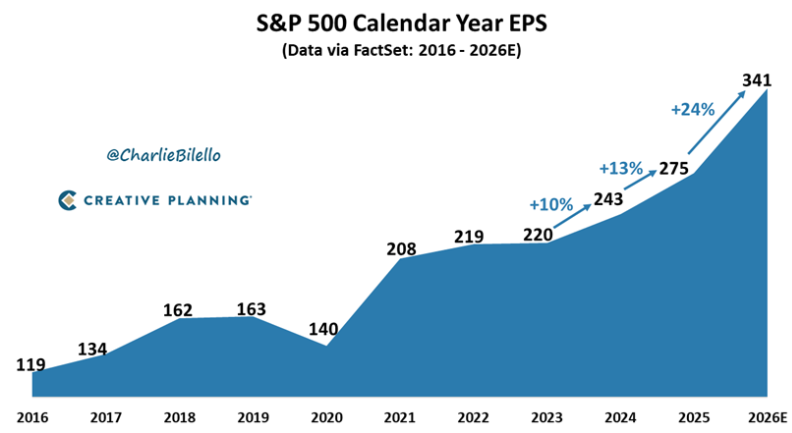
The most remarkable storyline over the last few years has been corporate America’s ability to generate incredible profits.
As you can see in the chart below, earnings are expected to grow by 24% in 2026, which might explain why the market has performed so well thus far despite the headline turmoil.
While continued earnings growth is great news for long-term investors like us, we should keep in mind that earnings cannot grow at this pace forever. And when they slow, we should expect (and prepare ourselves) for volatility to follow, knowing the media will surely report the slowdown as the end of the world. Our job will then be to respond opportunistically.
(Source: FactSet via Charlie Bilello)
TARIFF RATES HAVE STABILIZED:
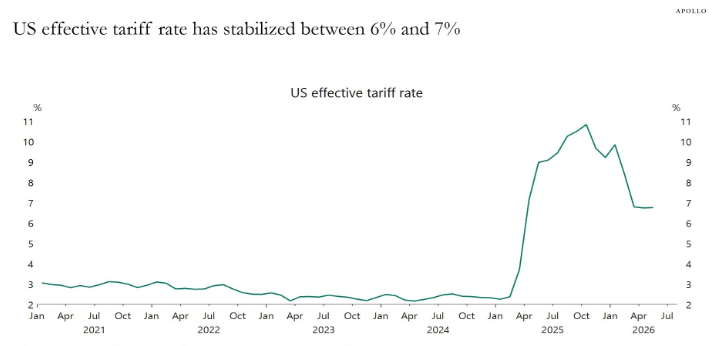
With so many competing headlines, people seem to have largely forgotten about tariffs, which remain in place. However, after the initial volatility triggered by tariffs in 2025, and the Supreme Court's ruling striking down many of the tariffs imposed under emergency powers, the effective tariff rate has finally settled between 6% and 7%.
While the broader policy backdrop remains uncertain, it's encouraging that the effective tariff rate has at least stabilized for now, giving companies the ability to make more informed long-term business decisions.
(Source: Apollo)
A REMINDER OF WHY WE DIVERSIFY (1 OF 2):
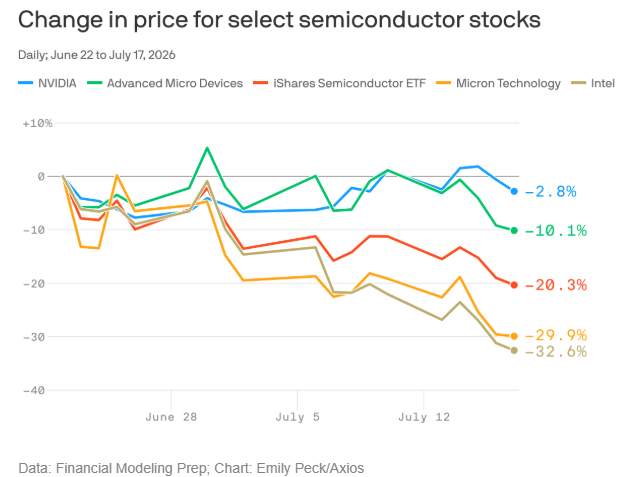
The A.I. trade has been one of the great, and ironically, perhaps one of the most hated, trades of recent years. But trees don't grow to the sky, and even the strongest trends rarely move in a straight line. Pullbacks and periods of sharp volatility are simply part of the deal.
For investors who felt the pull to go all-in on A.I., the recent decline offers a timely reminder of the risks of concentrating too heavily in any one company, sector, or investment theme. (Source: Axios)
A REMINDER OF WHY WE DIVERSIFY (2 OF 2):
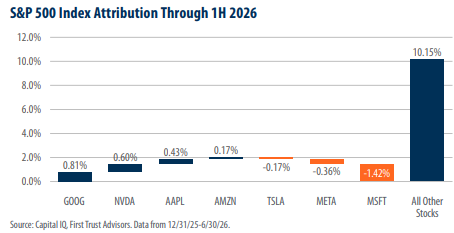
For a little while, investors seemed to think that the only thing they needed to do to earn a great return was to own the so-called “Magnificent 7.”
Well, through the first half of 2026, the seven collectively contributed essentially nothing to the return of the index, with Microsoft alone subtracting 1.42 percentage points, due to a 22% decline in its stock price.
In stark contrast, the other 493 stocks that make up the rest of the S&P 500 collectively contributed more than 10 percentage points.
The point here is that you never know when the tide will turn. And this, my friends, is why we diversify. (Source: First Trust)
INFLATION CONTINUES TO BE A MAJOR CONCERN:
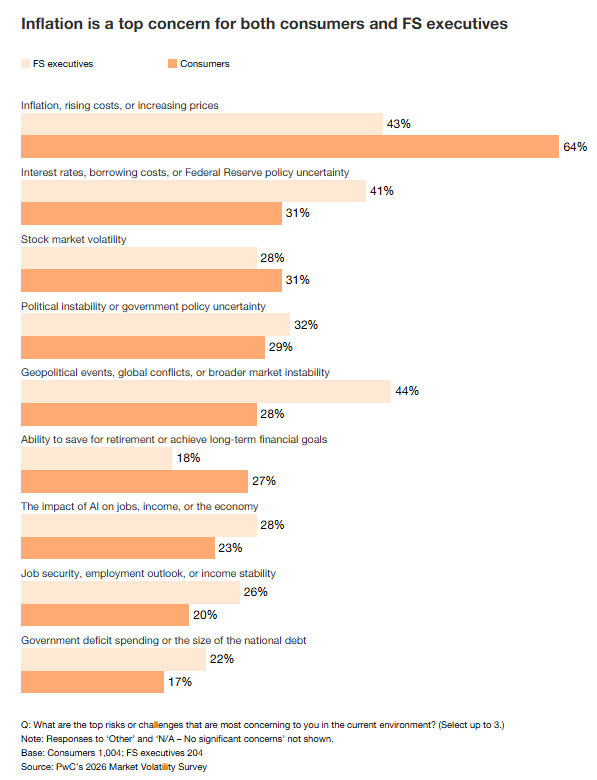
As gas prices have risen back above $4/gallon, inflation is once again atop consumers’ list of concerns. In fact, 64% of consumers recently identified inflation as one of their top concerns, which was far more than any other issue in the survey.
That concern is understandable, given that inflation climbed to 4.2% in May—a level last seen roughly three years ago—before easing to 3.5% in June. Thankfully, as I’ll share in the next chart, the new Fed Chair appears to be taking the inflation issue quite seriously.
(Sources: Chart: PwC; Gas Prices: AAA; Inflation: Trading Economics)
THERE’S BEEN AN ABOUT-FACE IN RATE EXPECTATIONS:
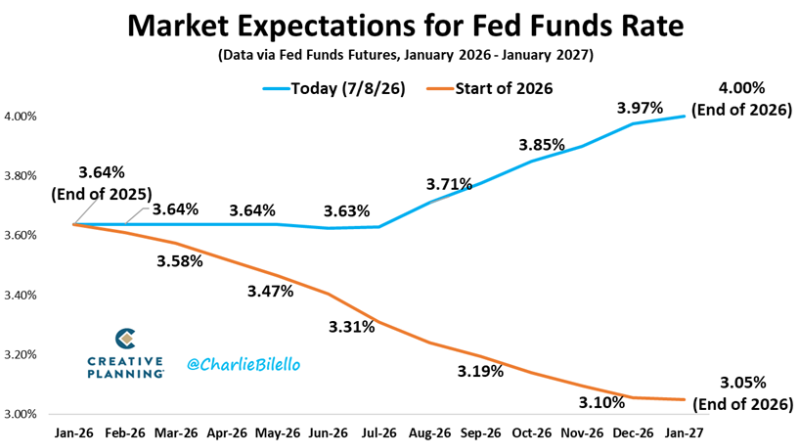
Coming into 2026, it was widely expected that the Fed would continue cutting rates by roughly half a percentage point. But amid renewed inflation concerns and Federal Reserve Chair Kevin Warsh’s emphasis on “price stability,” the market now expects rates to rise by roughly 30 basis points before year-end, effectively pricing in one rate hike and at least some possibility of a second.
How quickly things can change.
While there was some initial concern that Warsh might prioritize lower rates, it appears that the Fed will remain focused on getting inflation under control. And given the damage that persistent inflation can inflict across the economy, that is encouraging news. (Source: Charlie Bilello)
POLITICS CAN DISTRACT US FROM WHAT MATTERS:
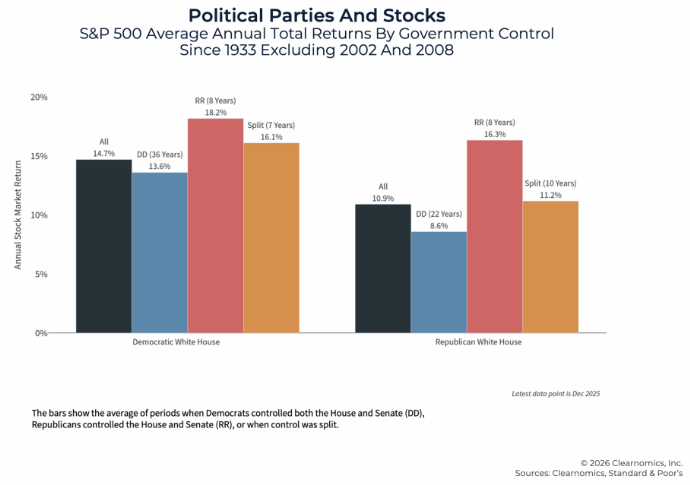
With the midterm elections looming, I’d like to remind everyone that political outcomes have historically mattered far less to long-term stock market returns than many investors assume.
While returns have varied depending on which party occupied the White House and controlled Congress, the most important takeaway is that every combination shown produced comfortably positive average annual returns.
The reason, of course, is that businesses continue to innovate, adapt, and, hopefully, generate profits regardless of which party is in power, which is what matters most to long-term investors. (Source: Kitces)
As is evident from the combination of charts above, there are plenty of conflicting storylines in the world today. Corporate earnings are expected to grow substantially, effective tariff rates have stabilized for now, and businesses may finally have a somewhat clearer environment in which to make long-term decisions. At the same time, inflation remains stickier than we would like, expectations for interest rates have completely reversed, and some of the market’s most popular investments have struggled mightily.
Taken together, these contrasting points offer a useful reminder that the investment environment is rarely all good or all bad. As counterintuitive as it may seem, earnings can remain strong while inflation rises and the broader market can perform well while its most celebrated companies struggle. The point here is that reality is almost always more complicated than the headlines make it seem, which is why diversification, patience, and discipline remain so important.
I hope these charts and commentary have been helpful in providing perspective on many of today’s headlines. As always, please don’t hesitate to reach out with any questions. And most importantly, stay the course.